
.Short-Term vs Long-Term Savings Goals Explained
An emergency expense can quickly disrupt financial stability, and the fact that 64% of Americans are unable to cover a $1,000 emergency highlights this vulnerability. This striking statistic demonstrates the importance of establishing clear savings goals—both short-term and long-term—to manage money wisely, build resilience, and stay prepared for unexpected challenges.
Knowing the difference between short-term and long-term financial objectives is vital. It helps in creating a well-rounded financial plan. This article will dive into why both goals are important and how to reach them.
Understanding short-term and long-term financial planning helps make better money choices. It ensures you stay on track with your goals.
The Psychology Behind Effective Savings Goals
Setting savings goals is more than just numbers. It’s about understanding the mind behind them. How we see and deal with our financial goals affects our success.
How Goal-Setting Affects Financial Behavior
Goal-setting shapes our financial actions. When we set clear savings goals, we make better financial choices. This focused effort helps us avoid spending too much and stay on track with our savings.
The Motivation-Action Connection in Personal Finance
In personal finance, motivation and action are closely linked. Motivation pushes us to set savings goals. The actions we take to reach these goals decide our success. Consistency is crucial; steady, disciplined actions help us meet our financial goals.
Overcoming Mental Barriers to Saving
Mental blocks, like fear of missing out or lack of self-control, can stop us from saving. To beat these, we can break big goals into smaller steps and surround ourselves with a supportive financial environment. As financial expert Ramit Sethi says, “Focus on making more money, not just saving it.”
“Rich people make money work for them; poor people work for money.”
| Psychological Aspect | Impact on Savings | Strategy for Improvement |
|---|---|---|
| Goal Setting | Provides direction and focus | Set clear, specific goals |
| Motivation | Drives action towards goals | Cultivate intrinsic motivation |
| Mental Barriers | Hinders savings progress | Break down goals, seek support |
Short-Term Savings Goals: Quick Wins for Financial Confidence
Starting with quick wins in personal finance is key. It’s about setting realistic short-term savings goals. These goals are vital for building momentum and confidence in your financial journey.
Short-term savings goals last from 0 to 3 years. They give you a clear target to work towards. This time frame helps you set achievable milestones that boost your financial health.
Defining the 0-3 Year Financial Horizon
The 0-3 year financial horizon is for goals you can reach soon. It includes saving for emergencies, planning vacations, or big purchases. Defining this horizon helps you focus on your immediate financial needs.
Popular Short-Term Savings Targets
Many people aim for specific short-term savings goals.
Emergency Funds
Creating an emergency fund is a key goal. It acts as a safety net against unexpected costs and financial setbacks.
Vacation and Travel Funds
Another goal is saving for vacations and travel. It lets you take breaks and recharge without debt.
Major Purchase Preparation
Preparing for big purchases, like cars or home appliances, is also a goal. It helps you save for important items.

The Psychological Benefits of Achieving Quick Wins
Reaching short-term savings goals boosts your sense of accomplishment. This motivation helps you move towards your long-term financial goals.
By focusing on short-term goals, you create a cycle of success and motivation. This drives you towards more financial achievements.
Long-Term Savings Goals: Building Your Financial Future
Securing your financial future is key. Long-term savings goals are vital for this. They are set for three or more years ahead and need careful planning and effort.
Understanding the 3+ Year Savings Timeline
Long-term savings goals are for three or more years. This time frame lets you invest more aggressively. It also means you can grow your money a lot through compound interest.
Critical Long-Term Financial Objectives
There are several important long-term savings goals. These include:
- Retirement Planning: Building a nest egg for a comfortable retirement.
- College Education Funds: Saving for your children’s college expenses.
- Home Ownership: Saving for a down payment or mortgage payments.
Retirement Planning
Planning for retirement is a big goal. It involves figuring out your future expenses and income. Then, you create a plan to save the difference.
College Education Funds
Saving for college is another big goal. Using tax-advantaged 529 plans is a smart strategy.
Home Ownership
Building funds for a home is a common goal. It can be for a down payment or ongoing mortgage payments.
Compound Interest: Your Most Powerful Ally
Compound interest is a powerful tool for growing your savings. It earns interest on both your principal and accrued interest.
Understanding and using compound interest can greatly improve your savings strategy. It helps you reach your financial goals more efficiently.
How to Set Realistic and Achievable Savings Goals

The journey to financial freedom begins with setting effective savings goals. It’s key to make your goals realistic and achievable. This helps you make progress in your financial journey.
Implementing the SMART Framework for Financial Targets
The SMART framework is a great tool for setting financial targets. It makes your goals Specific, Measurable, Achievable, Relevant, and Time-bound. This creates a clear roadmap for your savings.
For example, instead of saying “I want to save money,” a SMART goal is “I will save $10,000 in 12 months for a down payment on a house.”
Personalizing Goals Based on Income and Lifestyle
It’s important to personalize your savings goals based on your income and lifestyle. Think about your monthly income, expenses, and financial obligations. A budgeting strategy tailored to your situation will help you stay on track.
Creating Measurable Milestones for Progress Tracking
Breaking down your long-term savings goals into smaller, measurable milestones is key. This lets you track your progress effectively. It keeps you motivated and makes adjustments easier when needed.
For example, if your goal is to save $12,000 in 2 years, break it down into monthly targets of $500.
| Goal Type | Timeframe | Monthly Savings |
|---|---|---|
| Emergency Fund | 6 months | $500 |
| Down Payment | 2 years | $500 |
| Retirement | 10 years | $200 |
By following these steps and regularly reviewing your progress, you can achieve your savings goals. This will help you move closer to financial freedom.
Budgeting Strategies That Support Multiple Savings Goals
A good budget is key to managing different savings goals. It helps you move towards both short-term and long-term financial targets.
The 50/30/20 Approach to Balanced Saving
The 50/30/20 rule is a simple way to budget. It splits your income into three parts: 50% for needs, 30% for wants, and 20% for savings and debt. This balance lets you enjoy life now and save for later.
For example, if you make $4,000 a month, you spend $2,000 on needs, $1,200 on wants, and $800 on savings and debt. It’s a clear way to prioritize your savings.
“The 50/30/20 rule is a simple yet effective way to ensure that you’re saving enough without feeling deprived.”
Envelope and Zero-Based Budgeting Methods
Envelope budgeting uses cash for different expenses. You put money in envelopes for things like housing and transportation. It makes it easier to stay within your budget.
Zero-based budgeting, however, assigns every dollar to a specific expense or savings goal. This way, your income minus expenses equals zero. It encourages detailed financial planning.
| Budgeting Method | Description | Benefits |
|---|---|---|
| 50/30/20 | Allocate 50% to necessities, 30% to discretionary spending, and 20% to savings | Simple, balanced approach |
| Envelope Budgeting | Divide expenses into categories and allocate cash | Visual, helps stick to budget |
| Zero-Based Budgeting | Allocate every dollar towards expenses or savings | Thorough financial planning |
Automating Your Savings Plan for Consistency
Automating savings means setting up automatic transfers. This way, you save without having to think about it. It helps you stay on track with your savings goals.
Using these budgeting strategies, you can make a plan that fits your savings goals. Whether it’s for a house, a vacation, or retirement, you can get there.

Balancing Competing Savings Goals: The Art of Financial Prioritization
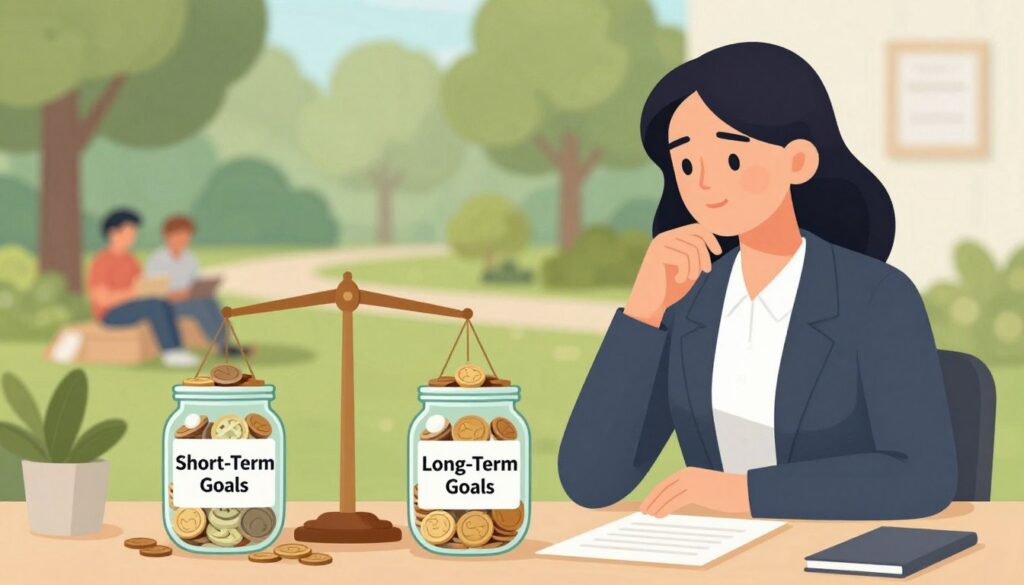
Financial prioritization is about balancing today’s needs with tomorrow’s dreams. It’s about making tough choices on how to use your money. You need to understand the value of both short-term and long-term savings. Then, find a balance that fits your financial life.
When Short-Term Needs Should Take Precedence
Short-term needs are often urgent and critical. For example, saving 3-6 months of living expenses is key. It helps avoid debt when unexpected costs arise. Prioritizing short-term goals ensures immediate financial safety and less stress.
Strategies for Simultaneous Goal Achievement
To reach multiple savings goals at once, you need a smart plan. Try dividing your income into different savings buckets. Use the 50/30/20 rule to guide you: 50% for needs, 30% for wants, and 20% for savings and debt. Automating your savings helps keep you on track with all your goals.
Adjusting Your Plan During Major Life Transitions
Big life changes, like marriage or kids, mean your financial plan needs a check-up. It’s crucial to update your savings goals to match your new life. This might mean reallocating funds or setting new targets. Regularly reviewing your plan keeps you on course, even with life’s ups and downs.
Investment Vehicles for Different Types of Savings Goals
Different savings goals need special investment plans to get the best returns and lower risks. The right investment vehicle depends on how long you have to wait and your financial goal.
Safe Havens for Short-Term Money Goals
For goals that are less than three years away, it’s key to focus on quick access and low risk.
High-Yield Savings Accounts
High-yield savings accounts are great for short-term goals. They have higher interest rates than regular savings accounts. Plus, you can get your money easily.
Certificates of Deposit
Certificates of Deposit (CDs) give a fixed return for a set time. They are safe but you must keep your money in the CD to avoid penalties.
Money Market Accounts
Money market accounts offer good interest rates. They also come with debit cards or checks, making them easy to use for short-term savings.
| Investment Vehicle | Liquidity | Risk Level | Return |
|---|---|---|---|
| High-Yield Savings Accounts | High | Low | Variable |
| Certificates of Deposit | Low | Low | Fixed |
| Money Market Accounts | High | Low | Variable |
Growth-Oriented Options for Long-Term Objectives
For long-term goals, you can try riskier investments to get higher returns.
Retirement Accounts (401(k)s and IRAs)
Retirement accounts offer tax benefits that boost long-term savings. 401(k)s and IRAs are popular, with different rules and limits.
Index Funds and ETFs
Index funds and ETFs give wide market exposure and diversification. They often have lower fees than actively managed funds.
Real Estate Investment Considerations
Real estate can be a good long-term investment. It offers rental income and property value growth.
“Diversification is the only free lunch in investing.” – Harry Markowitz
Risk Assessment Based on Time Horizon
The time you have to invest affects how much risk you can take. Generally, the longer you have, the more risk you can handle.

Overcoming Obstacles on Your Path to Financial Success
Reaching financial success means facing unexpected challenges. Good money management is about setting goals and being ready for hurdles. It’s not just about planning, but also being flexible.
Navigating Unexpected Financial Emergencies
Financial surprises, like medical bills or car repairs, can upset your plans. Having an emergency fund is key. It should cover 3-6 months of living costs, offering a safety net.
Maintaining Motivation During Economic Uncertainty
When the economy is shaky, staying focused on your goals is tough. Keep your eyes on the long-term benefits. Remembering why you set your goals can boost your motivation.
Course-Correcting After Missing Financial Targets
Missing your financial goals is not a failure. It’s a chance to review and tweak your plan. Find out why you missed and adjust your budget or investments as needed.
Being ready for financial surprises, staying motivated in tough times, and adjusting when needed helps you reach your goals. It’s all about being prepared and flexible.
Conclusion: Creating a Personalized Roadmap for Your Savings Goals
Reaching your savings goals needs a careful plan. It’s about understanding why you save, setting both short and long goals, and managing your money well. This way, you can make a plan that works just for you.
First, think about what’s most important to you financially. Look at your current money situation. Use tips like the 50/30/20 rule and set up automatic savings to fit your life. This helps you deal with sudden money issues and keeps you focused on your goals.
The secret to good money planning is a savings plan that you can really do. Mix the ideas and strategies we’ve talked about. This will help you make a plan that matches your goals and sets you up for financial success in the long run.